
Team visibility
Your client read your team’s LinkedIn profiles before they read your proposal.
And what they found decided the bid before you received a single line of feedback.
Run the five-minute testThe evaluation panel
The bid said one thing. The named team’s profiles said another.
Last time you submitted a bid, you named your team in it. Photographs, biographies, years of experience. The client did what every evaluation panel does before replying.
They looked up every name on LinkedIn.
I know because I have sat on those panels for more than three decades, across government, rail, space and financial services. We looked up every name. Every time. Before we scored a single page of the proposal.
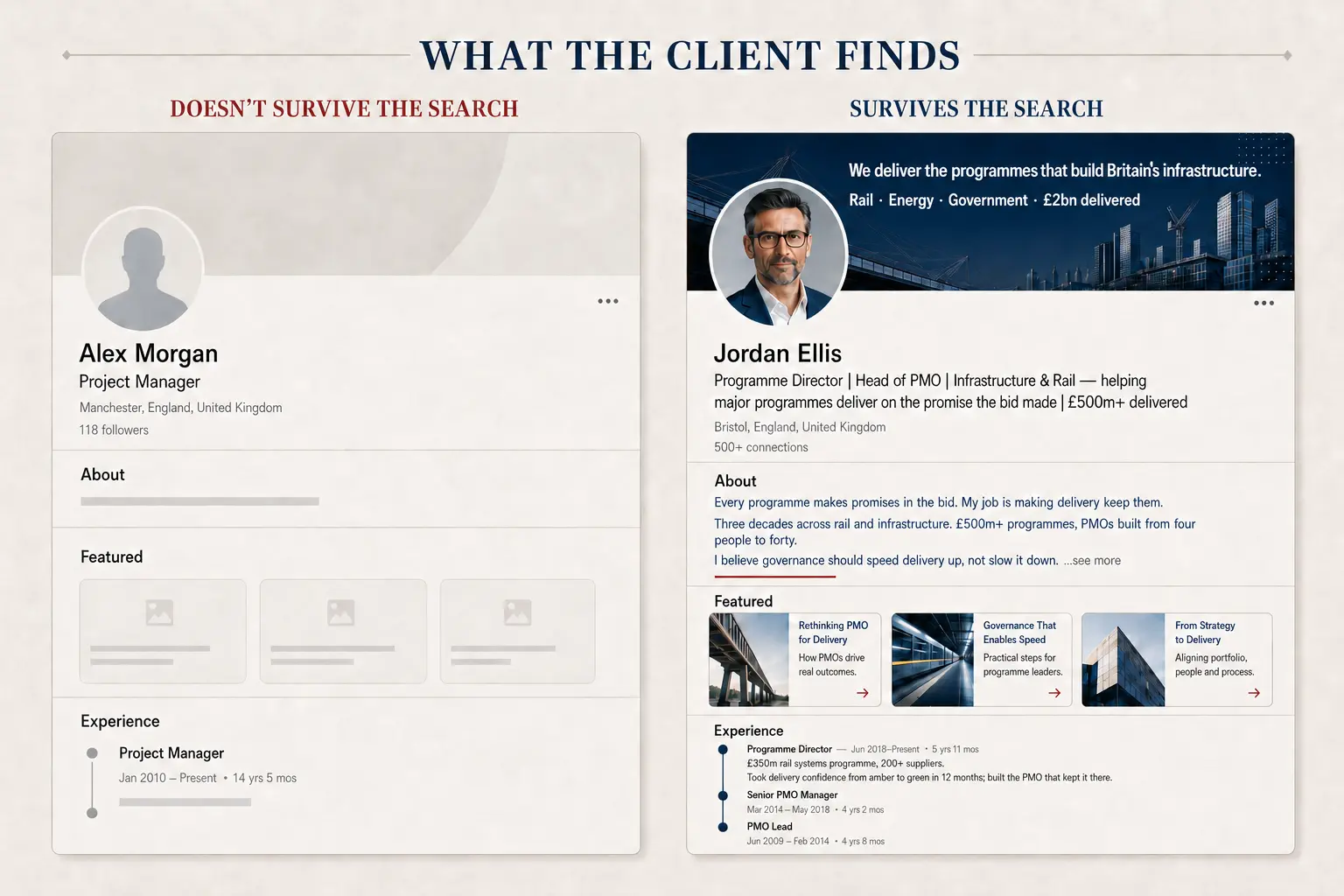
Here is what we usually found. The bid said senior transformation expertise. The profile said a job title, forty connections and nothing posted since 2019. The bid said proven delivery leader. The profile said nothing at all.
We believed the profile, not the proposal.
Nobody tells you this is why your bid went quiet. There is no feedback box for “your people looked less impressive than your document claimed.” The bid just dies, and you write it off as price or politics.
No formal bids? Same story. Before the framework call-off, before the direct award, before the renewal, before the second sales meeting, somebody looks up the people. Sales calls it due diligence. Marketing calls it brand. The client calls it checking.
Every route to revenue ends the same way: a human checking the humans behind the promise.

The deck gets fact-checked
The same thing happens to your pitch deck.
Your business development team builds a beautiful capability deck. Your best people, their experience, their sector credentials. Anyone with half a brain takes that deck and checks the names against LinkedIn to see how much is real and how much is theatre.
If the deck and the profiles do not match, the deck loses. Your marketing collateral is being fact-checked against pages you have never looked at and do not control.
Why people stay invisible
Your people learned that visibility was dangerous.
A few years ago I posted on LinkedIn about a government project. My post supported the project. It made the case for it better than the project’s own press office had managed.
Within days, that press office rang my employer. My employer rang HR. HR rang me and asked why I was posting about project management.
I am a project manager. What did they think I would post about?
That is the pathology inside most practices. Nobody directs visibility, so everybody polices it. Comms panics after the fact. HR asks questions. People learn the lesson fast: the safest profile is a bland one.
The pathology
You built the wall. You are paying for it in lost work.
Your practice is full of capable people who keep their profiles deliberately empty, even though they know it hurts them, because the one time someone put their head above the parapet, the company shot at it.
Then your bids go in, the client looks everyone up, and finds a wall of inconsistency. The proposal says this person is a senior transformation lead. Their profile says otherwise, or says nothing at all. Now the client is asking the only question that matters: what is the truth? If the document and the people do not match, what exactly were we about to pay for? Can this company deliver what it claims, when its own team’s evidence does not back it up?
No worthwhile client asks those questions out loud. They just score you down and move on.
The fix
Governed advocacy instead of policed silence.
You cannot order anyone to rewrite their profile. But you can sponsor it.
The company funds and supports the work. In return the profiles carry the company backdrop, accurate role titles and job descriptions everyone has agreed. The individual gets a credible professional profile at no cost to them. The company gets a named team that survives client scrutiny, capability that is visible to the bid team before the bid starts, and a workforce that advocates instead of hides.
The proposal maps your team’s ability to the client’s specific requirement. The profile does a different job. It corroborates. It does not need to repeat the bid, and it should not. It needs to make the bid believable when the client goes looking.
Comms writes the guardrails instead of making panicked phone calls. Everyone knows what good looks like.
The uniform
The dress code went digital.
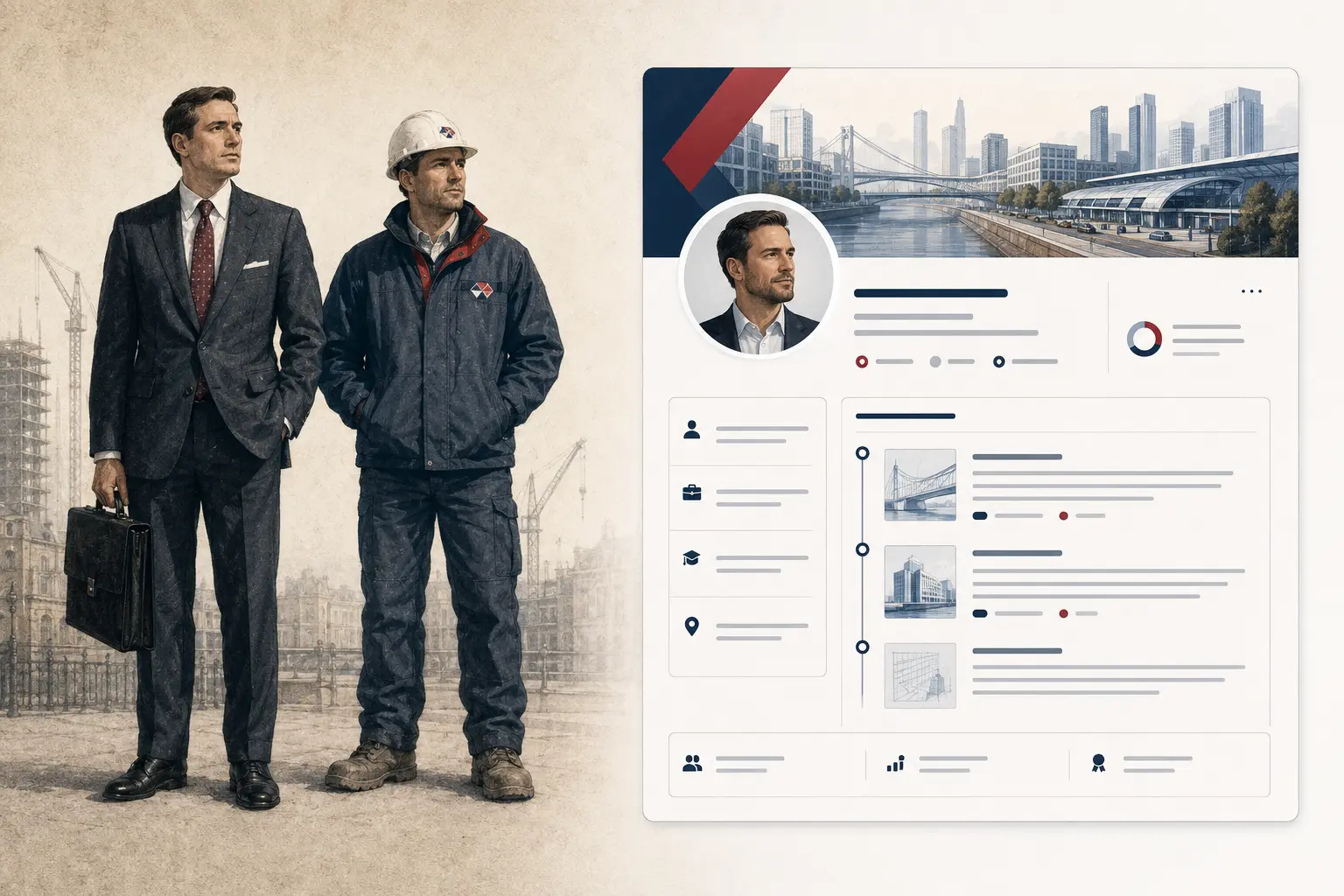
When I started work thirty years ago, the rule was simple. Suit. Tie. White shirt. Polished shoes. Not because the company cared about fashion, but because when we stood in front of a client, we represented the business. Looking competent was part of the job.
On site it was even simpler. The company handed you the uniform. Trousers, jacket, boots, the lot, with the company name on it. You wore it because you were the company standing in front of the client.
Thirty years on, the client rarely meets your team in person first. They meet them online. The profile is the suit now. It is where the client decides whether the people behind the proposal look like an organisation that delivers.
Most companies still enforce the suit and ignore the profile. The dress code went digital and nobody updated the policy.
Sponsoring your team’s profiles is not a perk and it is not personal branding. It is the uniform, reissued for the way clients meet you now.
The objections
The reasons organisations give for leaving the problem untouched.
“It’s their page, not ours.”
True. Legally the profile belongs to the individual. So ask yourself why you check it.
You check it before you interview someone. You check it before a review. I know because it has been brought into rooms I sat in. You already treat their profile as evidence about your business.
You inspect it constantly. You have just never invested in what you inspect.
“Won’t recruiters poach them?”
If a polished LinkedIn profile is enough to lose someone, you had already lost them.
People leave bad environments and empty pipelines. No amount of enforced blandness will retain anyone. It just means they update their profile on the way out, when it no longer does you any good.
Visible people with a full pipeline stay. Invisible people with an empty one go.
“Won’t it pigeonhole people?”
Vague internally is not the same as credible externally. To keep deployment options open, organisations keep everyone vague outside the business. Then the client looks up the named team and finds nothing convincing.
The answer is two designed views: full capability visible inside, positioned credibility outside. That is a design job, not a policy memo.
“Why wouldn’t we just do this in-house?”
Run it internally and it reads as instruction. People comply, minimally, and it shows. Run it externally and it reads as development, the same way PRINCE2 or PMP does: funded by the business, delivered by an accredited outsider, owned by the individual.
External carries a credibility that internal cannot, and it produces the thing you actually want: every profile aligned to the company standard, each one still sounding like the person.
Because clients follow people, not companies.
What the engagement covers
Make the next named team survive the client’s fact-check.
- Audit the named bid team against the last submitted bid and what a client could verify publicly.
- Design the visibility strategy and guardrails with communications, HR, sales, marketing and senior leadership.
- Agree role and title standards so the proposal, profile and operating reality tell the same story.
- Enable individuals with opt-in support so credible visibility is sponsored rather than imposed.
- Create a before-and-after evidence pack that shows what changed and what the next bid team can reuse.
- Induct new joiners into the standard as they arrive, so the practice never drifts back and every future bid team is ready before it is named.
The value question
Put the investment in the right category.
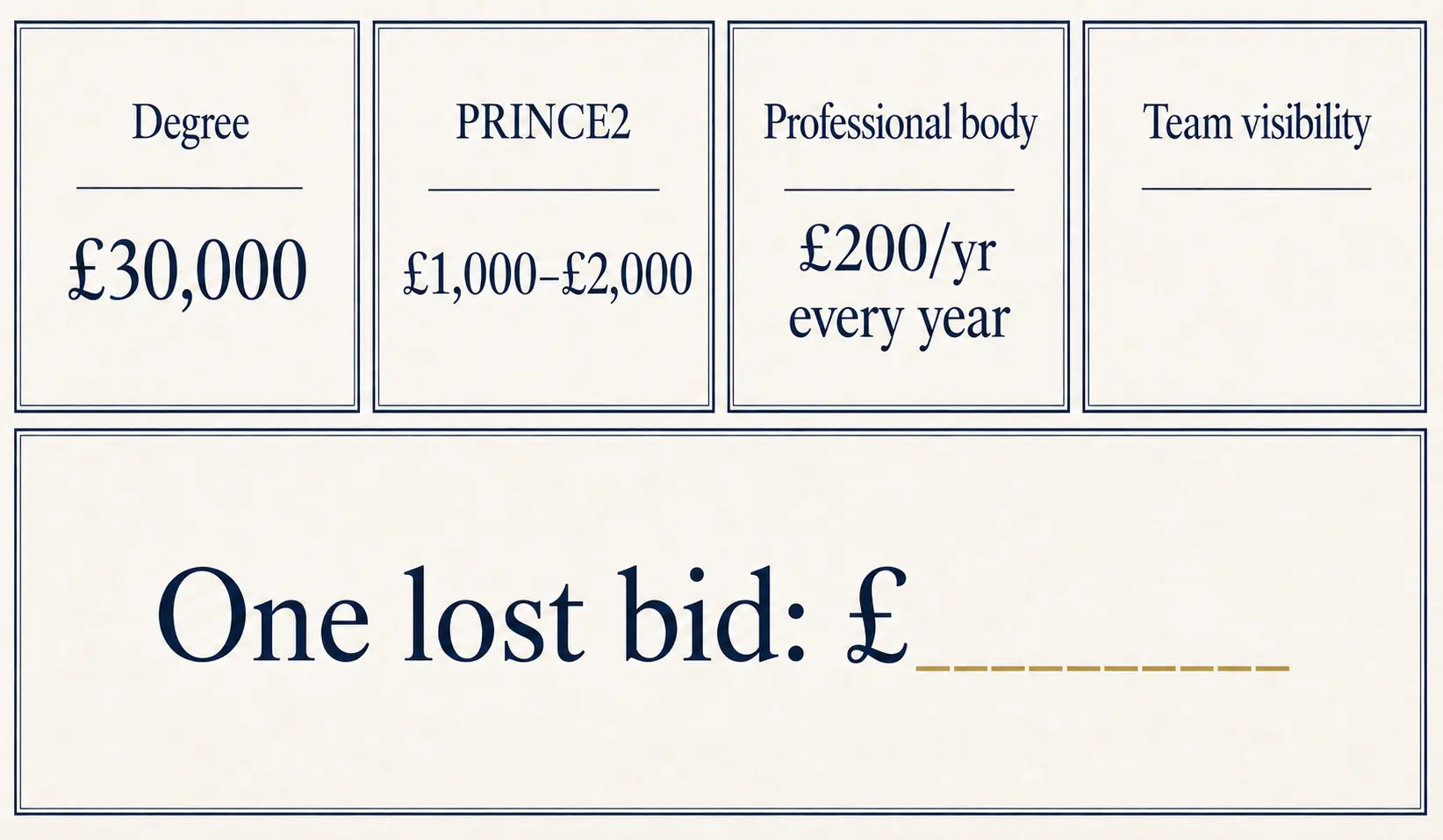
A degree now costs nearly £30,000 in tuition alone. PRINCE2 Foundation and Practitioner costs £1,000–£2,000 per person. Professional body membership costs a couple of hundred a year, for an entire career. Organisations already fund professional capability and credibility, per person, year after year.
This belongs in the same category of spend. It is not a bonus, a perk or an exercise in personal branding.
Now ask the commercial question: what did the last lost bid cost in fee income? Set the work against one recovered bid. The maths does the selling.
Anchored scope
We agree the company position before we touch a single profile.
I will need to meet HR, sales, marketing and senior leadership. We establish what the business is trying to achieve, what can be said, what must be evidenced and what the named team needs to communicate.
- 01Agree the commercial and organisational position.
Align leadership, communications, HR, sales and marketing around the purpose and guardrails.
- 02Audit the evidence the client can see.
Compare the proposal, capability deck and named team profiles against the claim being made.
- 03Design and enable the visible practice.
Apply agreed standards with individual participation, then capture the evidence for future bids.
This is organisational design and commercial enablement, not a profile-writing service.
What you risk
Prove or disprove the problem before you speak to me.
- Pull your last submitted bid.
- List every person named in it.
- Look up each profile on LinkedIn.
- Read what the client read.
If the profiles support the proposition, there may be nothing to fix. If they weaken it, you have found the problem using your own evidence.
The next move
Bring me what you found.
Thirty minutes. Bring the last bid and the profiles behind it. I will tell you what the mismatch may be costing and what fixing it involves.
I built a global project management practice from zero to more than one hundred people across four countries, and I have led governance and delivery across programmes worth more than £1 billion.
Compalley exists to make practices like yours win work, grow their people and scale reliably.
Assume the client will look them up. Decide what they find.
 James J BaileyConsulting Director, Compalley
P.S. Pull the last bid. Look up every named person. Read what the client read. If the profiles weaken the proposition, bring me what you found.